Resume Tailor Skill
Context
As an AI Product Manager looking for my next role, I was applying to dozens of positions — each requiring a tailored resume. Writing each one from scratch was unsustainable. Using the same generic resume undersold my fit for specific roles. And pasting job descriptions into ChatGPT or Claude produced inconsistent results every time: hallucinated experience, varying bullet styles, and no stable formatting. I needed something more systematic, so I built a Claude Code skill that could do it reliably.
Challenge
Tailoring a resume well means more than swapping keywords. The system had to research each company, understand what hiring managers actually care about, match real experiences from a persistent library, and produce consistent ATS-ready output — all without fabricating or exaggerating anything. And it had to work reliably across dozens of applications, not just once.
Approach
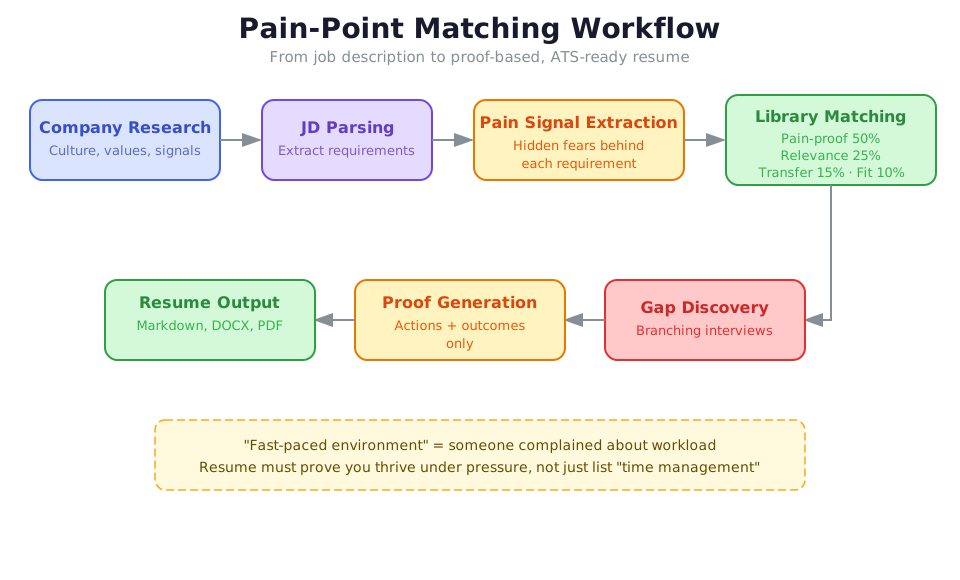
I designed a multi-phase agentic workflow inside Claude Code. The skill starts by researching the target company via web search — culture, values, terminology — then parses the job description to extract pain signals: the hidden fears behind each requirement.
It maps these signals to a persistent master library of achievements, scoring each match on pain-proof strength (50%), direct relevance (25%), transferability (15%), and impact fit (10%). A branching discovery phase surfaces undocumented experiences through conversational interviews when gaps appear.
The professional summary is generated as a direct hook addressing the hiring manager's primary fear. Finally, the skill generates Markdown, DOCX, and PDF outputs, uploads them to a structured Google Drive folder per company, and optionally updates the master library so it grows smarter with every resume generated.
Key Decisions
Shifted from keyword matching to pain-point hunting as the core matching strategy.
Keywords tell you what skills to list; pain signals tell you what to prove. Phrases like 'fast-paced environment' reveal that someone complained about workload — the resume needs to demonstrate you thrive under pressure, not just list 'time management.' This reframe made the output dramatically more persuasive.
Built a persistent, self-improving experience library rather than starting from scratch each time.
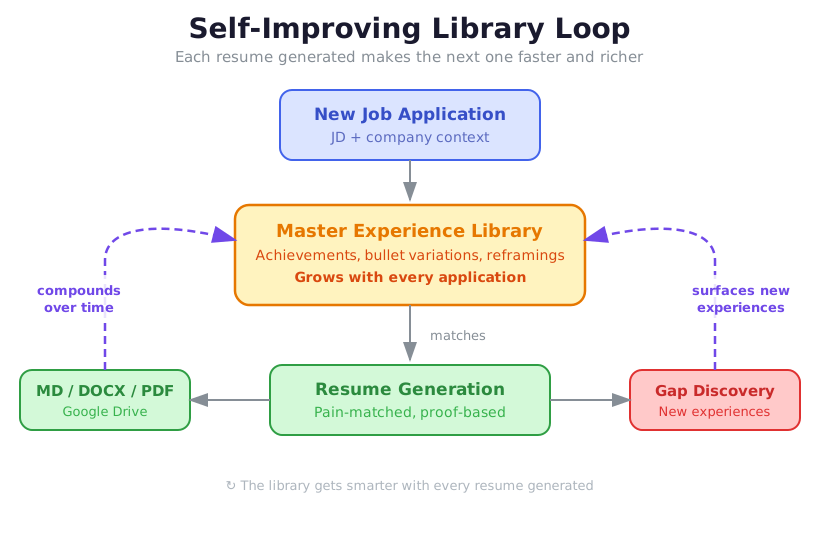
Each resume generation captures new experiences, reframings, and bullet variations. Over time, the library compounds — making subsequent resumes faster to generate with richer content options. This turns a one-off tool into a system that gets better with use.
Enforced proof-over-mention as a hard constraint in bullet generation.
Early outputs included meta-commentary like 'demonstrating cost-effective AI delivery at scale.' This sounds impressive but proves nothing. The constraint forces every bullet to state actions and outcomes only — cutting explanatory filler that weakens impact.
Impact
- Cuts resume tailoring time from hours to minutes per application
- Pain-point matching surfaces what hiring managers actually need proven, not just keyword overlap
- Self-improving library compounds across job applications, growing richer with each use
- Branching discovery interviews surface undocumented experiences that would otherwise never appear on a resume
- Truth-preserving philosophy ensures every claim is factually grounded — reframed for fit, never fabricated
Reflection
The biggest lesson was that resume tailoring is fundamentally a psychology problem, not a text-matching problem. Once I reframed job descriptions as fear maps rather than requirement lists, the quality of the output jumped. The skill also taught me how much undocumented experience people carry — the branching discovery phase consistently surfaces work that users forgot or dismissed as irrelevant. If I were starting over, I'd build the persistent library from day one — the compounding effect is the skill's most powerful feature.